“What I cannot create, I do not understand.”
Richard Feynman
Demystifying the Black Box
pip install a library, pass data to a pre-trained model, and output predictions. But when a model diverges, when gradients vanish, or when optimization stalls, standard software debugging tools fall short. You cannot patch an optimization surface you cannot visualize, nor fix an activation function you do not deeply understand. Inside Deep Learning is a pedagogical exploration designed specifically for engineers and developers who already know how to write clean, efficient code but want to bridge the gap between abstract mathematics and practical execution.
This is not a repository for high-level wrappers or superficial tutorials. It is a rigorous journey from first principles. Here, we break down core machine learning architectures, derive their mathematical foundations, and reconstruct them step-by-step using raw
PyTorch and Jupyter Notebooks.
The Landscape: Where We Stand

Our Methodology: Code as the Ultimate Proof
The Intuition: Identifying the geometric or statistical problem we aim to solve.
The Mathematics: Deriving the loss functions, gradients, and optimization rules manually.
The Construction: Implementing the mechanics without relying on high-level abstractions like PyTorch's
nn.Module, before finally refactoring the code into production-grade patterns.
Roadmap of Explorations
Linear Foundations 📈
Before tackling non-linear deep networks, we master the bedrock of regression. We explore how continuous targets are modeled, optimized, and mathematically constrained.🤖 Simple Linear Regression - Single-variable mapping and Gradient Descent basics.
🤖 Multivariate Linear Regression - Scaling features up using matrix operations.
🤖 Multioutput Linear Regression - Simultaneously mapping vectors to vectors.
🔵 L2 Regularization - Constraining model complexity via mathematical penalties.
The Mechanics of Classification 📊
Moving from continuous outputs to discrete decisions requires transforming arbitrary real numbers into valid probability distributions.🤖 Multiclass Classfication - Implementing categorical cross-entropy and tracking decision boundaries.
➗ Softmax function and its Derivative - A rigorous mathematical breakdown of the engine behind probabilistic classification.
Deep Representations: Multilayer Perceptrons 🧠
Linear operations fail when data patterns interact non-linearly. Here, we introduce hidden layers and non-linear activations to approximate any continuous function.🤖 Multilayer Perceptron (MLP) - Building and training our first truly deep architecture.
➗ Gradients and Activation Functions - Analyzing how non-linearities shape backpropagation.
🔵 MLP for Classification - Combining neural depth with multi-class decision engines.
🔵 MLP like PyTorch - Refactoring raw implementations into idiomatic, modular structures.
Recommended Theoretical Companions 📚️
While this repository provides the implementation backbone, we recommend grounding your studies with these essential academic texts:Mathematics for Machine Learning (Deisenroth et al. (2020)) - For underlying linear algebra and calculus.
Deep Learning (Goodfellow et al. (2016)) - The gold standard for theoretical deep learning foundations.
Dive into Deep Learning (Zhang et al. (2023)) - An excellent interactive breakdown of modern architectures.
Star History ⭐
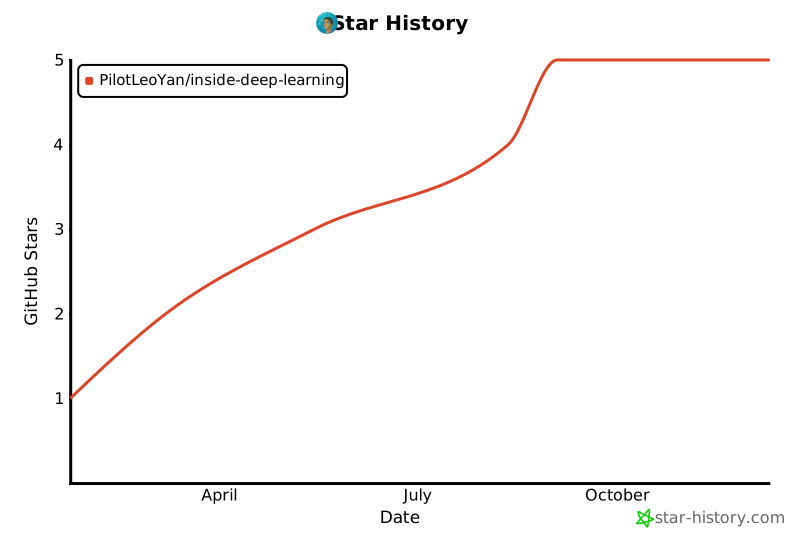
Give us a star if you like this content in our Github repo.
- Deisenroth, M. P., Faisal, A. A., & Ong, C. S. (2020). Mathematics for machine learning. Cambridge University Press.
- Goodfellow, I., Bengio, Y., & Courville, A. (2016). Deep Learning. MIT Press.
- Zhang, A., Lipton, Z. C., Li, M., & Smola, A. J. (2023). Dive into Deep Learning. Cambridge University Press.